How to Play Blackjack: Rules, Payouts, Basic Strategy, and 7 Tips
What Is Blackjack?

Blackjack is a card game in which you try to get closer to 21 than the dealer. It's a casino classic played all over the world. The rules are simple, but the decision at the heart of it — take another card, or stop here? — has real depth.
Yotsuba Games' Blackjack is free and runs right in your browser. It uses virtual in-game chips only, so no money is ever involved. This guide follows how the game actually works and covers the rules, payouts, controls, a general basic-strategy chart, tips for better decisions, and answers to common questions.
Basic Rules
Goal
Get a hand total as close to 21 as you can without going over, and beat the dealer's total. Going over 21 is a "bust," and you lose immediately.
Card Values
| Card | Value |
|---|---|
| 2–10 | Face value |
| J, Q, K | 10 |
| A | 11 or 1 (whichever keeps you at 21 or under, calculated automatically) |
The total on screen counts an Ace as 11 whenever that doesn't take you over 21. For example, an Ace and a 6 is shown as "17." A hand that counts an Ace as 11 is called "soft"; any other hand is "hard." If a new card would push a soft hand over 21, the Ace is automatically recounted as 1.
The Deck
The game uses one standard 52-card deck (no jokers), and reshuffles it before every round.
How a Round Plays Out
- On the title screen, choose a bet of 50, 100, 200, or 500 and press Start Game. You begin with 1,000 chips.
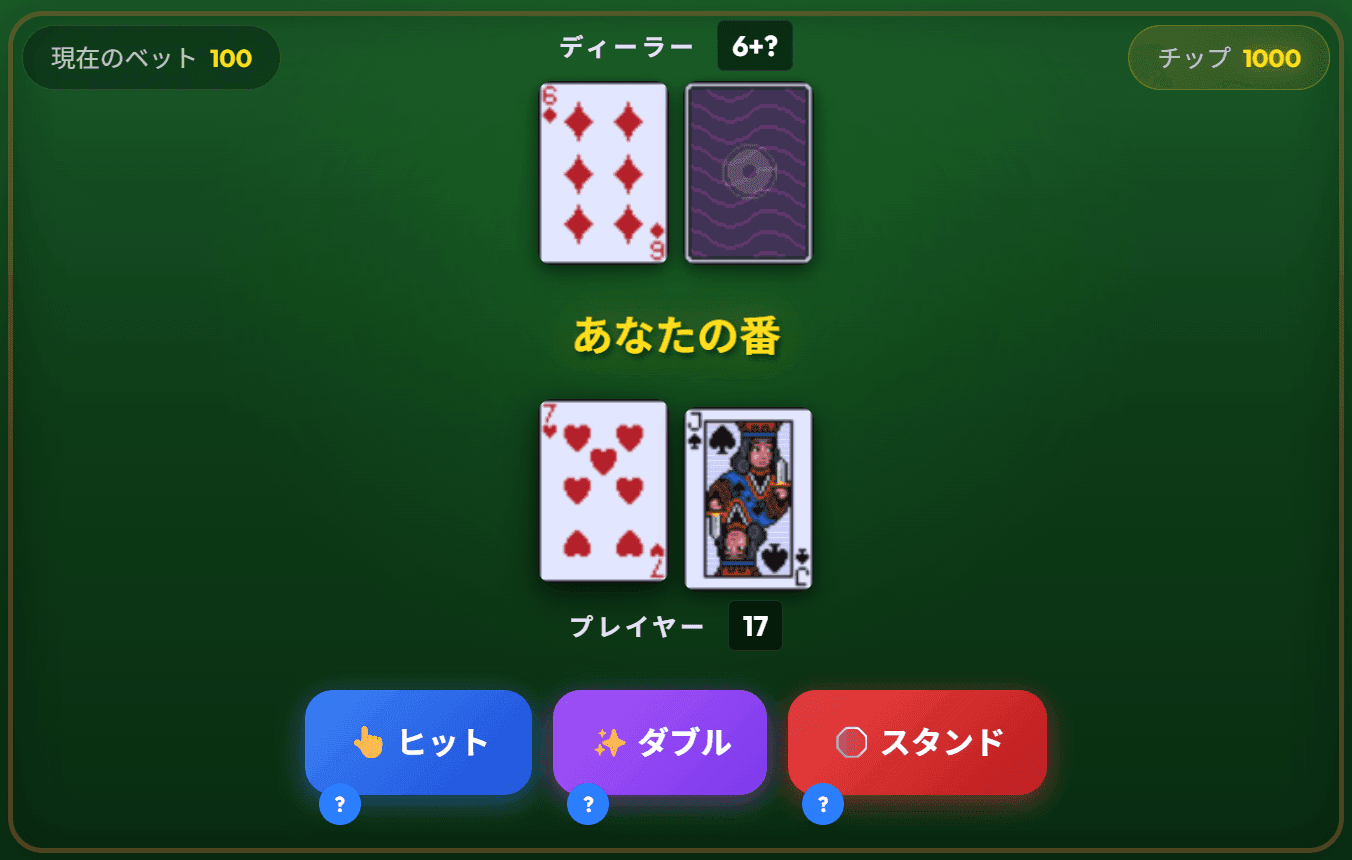
- You and the dealer each get two cards. The dealer's second card is face down, so the dealer's total shows only the visible card, like "10+?".
- You choose Hit, Double, or Stand.
- When you stand, the dealer flips the face-down card and draws until reaching 17 or more.
- Totals are compared, the winner is decided, and chips are settled.
Dealer Rules (Stands on Soft 17)
The dealer draws on 16 or less and stops on 17 or more. The dealer also stands on a soft 17 — a 17 that counts an Ace as 11, such as Ace-6. The dealer makes no choices and simply follows this rule.
Your Actions
| Action | What It Does |
|---|---|
| 👆 Hit | Take one more card. Go over 21 and you bust. If you reach exactly 21, you stand automatically. |
| 🛑 Stand | Keep your current hand and pass the turn to the dealer. |
| ✨ Double | Double your bet, take exactly one more card, and stand automatically. Only available on your first two cards (before you hit), and only if you have at least your bet amount left in chips. |
There is no split, insurance, or surrender. Press the "?" next to any action button to read an explanation of it on the spot.
Results and Payouts
| Result | When | Chips |
|---|---|---|
| Win | Your total beats the dealer's, or the dealer busts | You win your bet (1:1) |
| Blackjack | 21 with your first two cards (an Ace and a 10-value card) | You win 1.5× your bet (3:2) |
| Push | Equal totals | Your bet is returned |
| Loss | You bust, or the dealer's total is higher | You lose your bet |
If your first two cards make a blackjack, the dealer's face-down card is revealed right away: if the dealer also has blackjack it's a push; otherwise you win. If you bust, you lose before the dealer draws any cards.
Note that in this game the dealer's face-down card isn't checked until your turn is over. If the dealer's first two cards make 21, you lose with any total under 21 and push with 21.
About Chips
Chips are virtual and exist only inside the game — they have nothing to do with real money. Your chip count is shown at the top right, and your current bet at the top left. Chips aren't saved, so reloading the page starts you again at 1,000.
Controls
Click with a mouse on PC, or tap on a phone or tablet. The game uses a portrait layout, with the dealer at the top and your hand at the bottom.
- Title screen: pick a bet (50, 100, 200, or 500) and press Start Game. The 🌐 button at the top right switches between Japanese and English.
- During play: use the Hit, Double, and Stand buttons at the bottom. When doubling isn't allowed, the Double button is dimmed.
- Results screen: shows the outcome and your chip count. "🔄 Play Again" starts the next round right away, and "🏠 Back to Title" returns to the title screen, where you can choose a different bet.
Cards are dealt and drawn by the dealer with short pauses, so you can follow each card as it lands.
Basic Strategy at a Glance (General Guidance)
Blackjack has a well-known approach called basic strategy: for each combination of your total and the dealer's face-up card, it lists the play generally considered best. The charts below simplify commonly cited basic strategy to fit this game's rules (the dealer stands on soft 17, and only Hit, Stand, and Double are available). Treat them as a guide, not a guaranteed way to win — the idea is to reduce the house edge over many hands.
Hard Hands (No Ace, or the Ace Counts as 1)
| Your total | By dealer's face-up card |
|---|---|
| 17 or more | Always stand |
| 13–16 | Stand vs. 2–6; hit vs. 7–A |
| 12 | Stand vs. 4–6; otherwise hit |
| 11 | Double vs. 2–10; hit vs. A |
| 10 | Double vs. 2–9; hit vs. 10 or A |
| 9 | Double vs. 3–6; otherwise hit |
| 8 or less | Hit |
Soft Hands (The Ace Counts as 11)
| Your hand | By dealer's face-up card |
|---|---|
| Soft 19 or more (A-8, A-9) | Always stand |
| Soft 18 (A-7) | Stand vs. 2–8; hit vs. 9–A |
| Soft 17 or less (A-2 to A-6) | Hit |
Full basic-strategy charts also include some soft doubles when the dealer shows a weak card (roughly 3 to 6). Here they're folded into hit or stand to keep things simple.
Since this game has no split, pairs are played by their total: 8-8 is a hard 16, 5-5 is a hard 10, and A-A is a soft 12 (hit, like the "soft 17 or less" row).
One more thing to keep in mind: because the dealer's blackjack isn't checked up front, doubling against a 10 or an Ace can cost you your doubled bet if the face-down card completes a blackjack (if your double makes 21, it's a push).
7 Tips for Better Blackjack
1. Start by Looking at the Dealer's Face-Up Card
The dealer always draws to 17 or more, so the face-up card has a big influence on how strong the final hand ends up. It's generally said that a dealer showing 2–6 is more likely to bust, while 7 through Ace tends to end up strong. Make your decision with both your hand and the dealer's card in mind.
2. You Can't Bust on 11 or Less
No single card adds more than 10 (an Ace can always count as 1), so with 11 or less, one more card can never take you over 21. Hit without hesitation — or double, if the situation is right.
3. A Soft Hand Can't Bust on One Hit
When your Ace is counted as 11, it automatically switches to 1 if a new card would push you over 21. That means a soft hand can always take one more card safely. Even when the display reads 17 or 18, a soft hand can sometimes be hit with confidence.
4. Doubles Are Best on 10 and 11
Doubling gets you only one more card but twice the bet. Totals of 10 and 11, where the next card often makes a strong hand, are generally considered the classic doubling spots. You can only double on your first two cards, so decide before you hit.
5. Let the Dealer's Card Decide Hard 12–16
Hard 12 to 16 is the trickiest range: hitting risks a bust, but standing often loses. The general basic-strategy idea is to stand and let the dealer bust when the dealer's card is weak, and hit to improve when it's strong. With a hard 17 or more, stand.
6. Don't Read Anything Into Previous Rounds
This game reshuffles all 52 cards before every round, so the cards from one round have no effect on the next. There's no need to think "lots of 10s came out last time…" — just decide based on your current hand and the dealer's face-up card.
7. Start With Smaller Bets
You begin with 1,000 chips and can bet 50, 100, 200, or 500. While you're getting used to the rules and basic strategy, smaller bets let you play more rounds. Since the chips are virtual, it's the perfect place to try different decisions and build a feel for the game.
Frequently Asked Questions
Does the dealer hit on soft 17?
No. The dealer stops at 17 or more, including a soft 17 such as Ace-6.
Can I split, take insurance, or surrender?
The game offers three actions: Hit, Stand, and Double. Split, insurance, and surrender are not available.
What does a blackjack pay?
3:2. For example, a blackjack on a bet of 100 wins you 150 chips (you get back 250 including your original 100). A regular win pays 1:1.
Is real money involved? Are my chips saved?
No money is used at all. Chips are virtual and aren't saved, so reloading the page starts you again at 1,000.
Does remembering which cards came out help?
Not in this game. All 52 cards are reshuffled before every round, so cards seen in earlier rounds have no bearing on the next one.
Related Articles and More Card Games
Yotsuba Games has more free card games besides Blackjack. If you'd like something to think through at your own pace, our solitaire guides are a good place to start.